Friday, August 21, 2015

Infinite and the finite

A conversation between two about a finite being understanding an infinite being


A: It is absolutely absurd for anyone to hold any sort of belief in any God, especially the Judeo-Christian version.

B: Why? What is so absurd about it?

A: The concept of God is so far fetched. How can a finite being even begin to understand an infinite being? It is impossible, so to even assert you know him or believe him is absurd, it is an impossibility.

B: You are a mathematician correct?

A: Yes.

B: So do me a favor, count to the number one for me.

A: Is this some kind of joke? One!

B: No no, I mean count all the numbers.

A: I am not quite understanding what you are asking of me.

B: Between zero and one there exist numbers right?

A: Yes.

B: About how many numbers exist between zero and one?

A: Its impossible to say, probably an endless amount of numbers.

B: An infinite amount of numbers would you say?

A: Yea that would be fair.

B: So why don't you count them when counting to one?

A: Because you would never get to one.

B: So does the number one even exist?

A: Well yes of course, you kind of have to set aside the absurdity of infinity in order to get past all of that.

B: But how can you grasp counting to any number if there exists an infinite amount of numbers in between? It may be absurd to count them but it certainly is also absurd to skip them.

A: What is your point?

B: My point is that despite the absurdity of the infinite amount of numbers between zero and one, you still can grasp and believe in the number one. Likewise, with God I realize that he is infinite and I am merely a finite being but I still am able to know Him and believe in Him, despite the absurdity of the infinite.

A: You believe because it is absurd?

B: I believe it despite the absurdity.


Wednesday, August 19, 2015

The Council of Chalcedon from an Oriental Perspective

I am by no means a great theologian, or well schooled in Christology. I am however very history minded and therefore this will be from a historical point of view. One thing that really rubs me the wrong way is when in discussion with an Eastern Orthodox Christian about this schism, the EO tends to tell the OO what they believe according to their understanding and then they attack it. This of course is not every EO that I have encountered but quite a number of them do this. Its perplexing to me that someone would not first ask the other what it is they believe, what is their perspective, and how they understand what took place.

The EO tend to point to Dioscorus as a heretic, adhering to a monophysite Christology simply because Dioscorus was trying to rehabilitate Eutyches who was in error. The fact is that even at the council Dioscorus was not condemned for heresy, there is no evidence for this whatsoever. This idea comes from later interpretation of Dioscorous' actions and not any decision by the council of Chalcedon. Dioscorus later did condemn Eutyches who persisted in his error of a monophysite Christology, which apparently is overlooked. But what about the Oriental Orthodox perspective which is almost entirely ignored by the Eastern Orthodox?

From our perspective we were very suspicious of Leo. Why? Well, like Dioscorus making the Eastern suspicious by supporting, and attempting to rehabilitate Eutyches, Leo supported Theodoret, a known Nestorian heretic. When Dioscoros read Leo's Tome he most likely thought it was suspicious in its wording, which is probably why he refused to read it. Not only that, Nestorious himself said that Leos Tome was a "vindication of the truth." So we had enough reason to be suspicious of Leo and his intentions to reject what was taking place at Chalcedon and the Antiochene formula. Of course in hindsight we know that Leo was not a heretic and that while he was friends with Theodoret he was attempting, like Dioscorus, to rehabilitate Theodoret, even rebuking his Nestorian Christology in letters to him.

You will find most, if not all, Oriental Orthodox accept both EO and OO formulas, namely because St Cyril himself affirmed that both formulas are Orthodox, even though he preferred the OO formula to the EO formula. The formula itself is pretty much a non-issue yet I find so many EO are obsessively focused on this, again telling us what it is we believe and then attacking it. Without ever actually asking what we believe, or if we even accept both formulas. We are not monophysite, never have been and never will be. We have adhered to St Cyrils formula of "One nature united out of two" which was accepted at the 3rd council. How exactly could that be Orthodox in one council and then heretical in the following council?

At any rate, we accept both formulas.


Wednesday, April 23, 2014

Mental Illness is a Reality


                        I have read and heard many so called intelligent people go on mad rants about how mental illness is not real. They cite odd sources and claim that this is made up for drug companies to make billions off of a made up diagnosis. Simple logic completely diffuses this argument, and while I am not supporting big pharma, I am supporting truth and truth alone. I also am not medical doctor so I will not try to use any scientific data, just logic.

                        We can look at a few things, brain injury for instance. When a person sustains any number of brain injuries they often end up exhibiting mood swings and other "non-existent" mental illness. Now, if mental illness is not true then the brain should not be affected in this way when it sustains injury, however, it does. There are no better examples then NFL players who often sustain many concussions and then show signs of bi-polar disorder, sometimes ending in suicide.

                        Drug addicts also tend to exhibit mental illnesses, namely those who use meth or bath salts. They show signs of extreme paranoia, delusions, mood swings, often very violent ones and even hallucinations. These even occur when the person is no longer using them even for an extended period thereby having a mental illness caused by drug abuse. If mental illness is not true then why does this occur? assuming it does not exist, then this should not happen.

                        Simple logic defuses such an argument and it is sad that mental illness is treated differently than those who abuse their bodies. In fact mental illness is less accepted than those who engage in violent sports that damage their brain or those who abuse drugs that damage their brain. Why is mental illness met with such hostility when simple logic shows that it exists, not on account of some greedy corporation but a legitimate reality? Stupidity.

Tuesday, January 28, 2014

Atheism Is Faith Based..Or Is It?

Atheism is defined as "the disbelief in God or gods."

There are some who argue against this definition, stating that it is biased because it was defined by theists. I assert that the definition is incorrect, but for a different reason. Assuming that this rational thinker has looked at the evidence for Christianity, and I say Christianity because I myself am an Orthodox Christian, and then rejected the Judeo-Christian God based upon the evidence, and there is evidence, or that they cannot make the leap from the evidence to faith, and that is totally rational. But, in that instance the person would be an atheist, but as I said I believe the definition is incorrect because in this instance the person has chosen to believe that the Judeo Christian God does not exist, based upon the evidence. You see, since there is inferential evidence and archaeological evidence, one would have to choose to believe that God does not exist. Not only that, God cannot be proven nor disproven, so why is one stance considered faith and the other not?

Now, let us assume that a person rejects the Judeo-Christian God without looking at the evidence, that person would then be described as an irrational thinker, not a rational thinker. Who rejects beliefs or views without first looking at the evidence, then making a judgment? Certainly this person cannot be considered a rational thinker.

On top of this, nobody defines themselves by what they disbelieve but by what they believe. It could pertain to anything, for instance one person may believe the earth is spherical, another may believe the earth is flat. Both believe that each others views are incorrect. I believe that the earth is not flat or I believe the earth is not spherical. Not, I disbelieve in a flat earth, which makes no real sense as we are then redefining language itself.

So I conclude that any rational thinker that does look at the evidence for the Christian religion, evidence that includes archaeological evidence, early church writers, even opponents of Christianity who clearly refer to Christ, and then comes to a conclusion is an atheist who believes the Judeo Christian God does not exist.

If you would like to look at the evidence to make your decision click here to purchase my book Reasonable Christianity. If you would prefer I send you a copy, email me tewahdo@gmail.com and I will send you a .pdf copy for free.

Friday, January 24, 2014

Christians Created Atheists


I am not sure when tensions between science and Christianity began but what I am certain of, although I may be wrong, is that Christians have created atheists. This may seem absurd since the objective of Christians is the exact opposite, but let me explain. When you know something and can prove it with indisputable facts, and someone outright rejects it because it conflicts with their interpretation of their beliefs or just their world view, that would upset you in some manner. This is exactly what many Christians have done, argued against fact because their interpretation of the bible comes before factual evidence. I can understand being skeptical about theories or ideas which may be based on inferential evidences, that is fine and actually serves to further science and critical thinking altogether. What is not fine is the kripkean dogmatist position that many Christians have taken, that despite the evidence I am going to reject it because of what I believe.

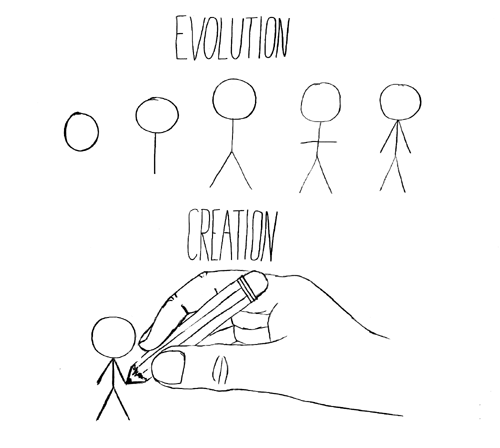
A good example of this is the account of creation in Genesis. There are many Christians who take this literally and thereby reject any scientific data that suggests a much different time frame and that it likely was the result of a big bang. First off, the account in Genesis is likely metaphorical, used to explain to people, who lack scientific understanding during the time in which it was written, how things came to be. The obvious reason this is metaphorical is that God rested on the 7th day, so unless Christians are willing to believe that the All Mighty is in need of rest, thereby finite in some way, they have to take the preceding verses as metaphors. We know the rate at which the universe is expanding, we can observe this, there is no doubt about it. Logically we can conclude that there was a point of origin, this also does not conflict with "let there be light" as that could be referencing the big bang, as God undoubtedly uses explainable means with which to work in His creation. He abides by the laws He created in space time.

What Christians need to understand is context, Genesis was written for a people who were not exactly astrophysicists and geologists, but poor slaves. Giving them detailed scientific explanations for how all creation came about is absurd, so logically very simple metaphors were used so that all people, even children, could understand. As we grow and learn we know that there are scientific explanations that are not contradictory to scripture, unless you  misinterpret them as literal.

Because so many of these Christians make a stand, they tend to infuriate scientists with their kripkean dogmatism and pompous attitudes towards what others have worked a lifetime to understand. It makes little sense to disrespect a scientist and his or her field of study, it is also disrespectful and arrogant to simply reject their knowledge and expertise on the basis of your own personal interpretation of scripture. This arrogance reflects on the beliefs the Christians claim to espouse, so logically someone on the outside would look at Christianity as a close minded religion in which all scientific evidence is rejected in favor of erroneous personal interpretations of scripture. If I knew nothing of Christianity and seen Kent Hovind debating someone, I would likely despise Christianity based on his actions. Kirk Cameron is another loonie that serves to push more people away from Christianity than it does open their eyes to its beauty. He has done more to close the minds of people than Aristotle has in opening them. Kirk Cameron does not define Christianity, in fact its quite the opposite. Early Christians were educated in the sciences and philosophy, they took time in understanding opposing views, not bashing them.

Kirk Cameron and Kent Hovind have done more to further atheism than any scientist has, in fact if you were going to convince someone to be an atheist, dont get them Richard Dawkins "The God Delusion" just show them how stupid and close minded these kripkean dogmatists like Cameron and Hovind are, if that doesn't do it, I don't know what will.

Friday, December 13, 2013

New Book In Progress

St John the Forerunner Publications has begun work on a new book which focuses on the apostasy spoken of by the Apostle St. Paul in 2 Thess. 2:1-3. We will periodically update everyone as to the status of the new book.

Wednesday, December 11, 2013

Word Association


         What is it that makes a word offensive? A word is a single distinct meaningful element of speech or writing, used with others to form a sentence. But what is it that gives a single word meaning, and especially an offensive one. Words are obviously our way of labeling things in our world in order to better communicate, however there are those words that when used elicit a negative response from those that hear. So we know that most words are used to define things in order for us to communicate, what makes particular words become offensive? Simply put, emotion. The emotion that we attach to words determines how offensive a word is, for instance, if I simply say the word “nigger” it would elicit a very negative response to those around me, but why? There is no context to the word, I just say it randomly. However, the fact that I am white puts that word into context before I even say it, even if I do not have any particular context in which I say it. Assuming the audience present is all black, the context is that I am white and white people do not say it, or the individual saying it is a racist.

A black man on the other hand can say the slag version of the word, “nigga” as many times as he pleases and it is not offensive to him or most other blacks. Some even have cited that this is an attempt to remove the alleged power from the word, but has it done that? No because the word as power based on the amount of emotion others put into it. That word does not have less power by saying it more, in fact I think you could argue the opposite. If I say “nigga” instead of “nigger” would that be less offensive to an audience of blacks? Perhaps to some it may not be as bad, but because I am white it is likely to still ruffle some feathers.

Even if I say “bitch” with an audience of women, I will get a very negative response, even if not directed at any one specific person. But why does this word elicit this response? Again, the emotional value you place on this word, or any offensive word, is what gives the word power. If we do not ascribe emotional value to specific words or phrases, then they do not have any power. I believe that when a person becomes upset about specific words that it is more of a reflection on them than the ones using it. They are allowing their emotions to dictate their behavior, they are allowing a simple word to offend them and upset them because of the emotion that they have ascribed to this word. Sometimes we even see people seeking to ban or stop the usage of certain words, what a display of insecurity. Because they are offended by a particular word they see the need to stop everyone else from using it. How about removing your emotional attachment from the word, then it no longer has the power to control you and your emotions. Making it illegal does nothing but give that word more power to control your emotions and numerous insecurities.

I assert that we should carefully choose which words we ascribe emotions to. We should ascribe emotion to words like love, not nigger or bitch. When someone tells me they love me, it says to me that they are willing to sacrifice themselves for me, as sacrifice is the epitome of love. Therefore I give that word power by attaching emotion to it. When it is said to me, it elicits a positive emotional response. Do not allow words to disturb your peace, if you allow that to happen then it is your own fault for having an emotional attachment to that particular word, whatever it may be.